
Why does every PI firm's ad look the same — and what actually breaks through?
A research-backed look at what actually moves the needle in personal injury advertising — and why the firms that dominate their markets are the ones that stopped looking like everyone else.
The market is huge, and almost everyone in it looks the same.
Personal injury firms spend more on advertising every year — and an increasing share is wasted, because the creative is nearly interchangeable from firm to firm. The opportunity isn't to outspend the market. It's to out-create it: cinematic production, a consistent campaign across every channel, and exclusive ownership of that look across your entire media market. Each lever is independently proven to drive results. The sections below lay out the evidence, with sources.
The scale of the opportunity.
The legal advertising market has grown explosively. The American Tort Reform Association estimates more than 30 million legal-services ads ran in 2025; spend estimates for the category range from about $3.2 billion in directly-tracked media (Taqtics) to roughly $4 billion in broader industry tallies — either way, a category that has grown sharply year over year. Television remains the single largest channel: legal services account for 6.12% of all local broadcast-TV impressions, so roughly one in every 16 local TV ads is a law firm.
Individual firm investment runs from $15K–$50K a month for a small-market firm up to $100K–$400K for a major-market TV leader. The takeaway for a mid-tier firm: the money is already being spent. The only question is whether the creative behind it is doing any work.
Sources: American Tort Reform Association (2025 report); Taqtics attorney-advertising data; Superpractice; MyCase.
90% of firms look identical.
The insight that validates this whole model isn't the size of the market — it's the creative gap inside it. When Taqtics audited the brands of 200 personal injury firms across 35 markets, the sameness was stark: 172 of the 200 used the same two primary colors (blue or red), and 146 used some variation of “fighting for you.” Across their wider tracking of 3,720 advertisers in 210 markets, the same pattern holds — roughly 90% of PI firms look interchangeable side by side. That's not a branding failure so much as a branding absence: when every firm looks the same, none of them registers.
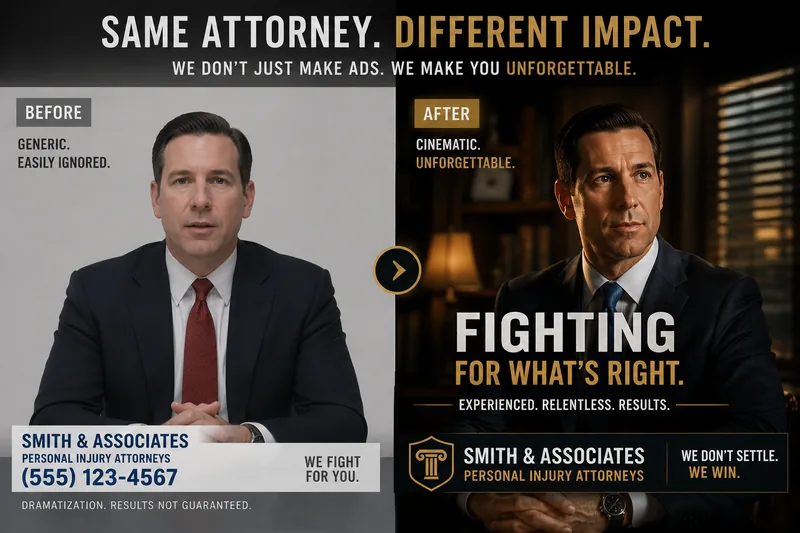
When brands appear interchangeable, clients default to price or proximity. And when every firm leans on the same words — “experienced,” “aggressive,” “results-driven” — those words stop differentiating at all. The firms that escape this “sea of sameness” share one trait: they built something recognizable at the market level. The opportunity is to be that firm — without outspending fourteen competitors to do it.
Sources: Taqtics law-firm branding audit; PaperStreet; National Law Review; Legal 500.
“Cinematic” is a measurable business lever, not a style preference.
Synthesizing data from more than 500 video campaigns alongside neuroscience and cognitive-psychology research, ADVIDS documented a direct relationship between production quality and how credible a brand is perceived to be — a jump from a credibility score of 35 for low-production work to 85 for cinematic work. That's a 143% improvement in perceived credibility from production investment alone, before a single word of copy is written.
Message retention from video versus text. The brain processes visuals far faster than words — and for attorneys, retention and trust are the direct precursors to a phone call.
Effie & System1's “Creative Dividend” research across 1,265 campaigns found creative quality can increase advertising profitability by up to twelve times versus the average advertiser in the same category.
That last figure is the one that matters most: the same media spend, with demonstrably better creative, doesn't produce incrementally better results — it produces an order-of-magnitude improvement. Ads in premium environments also generate markedly higher unaided recall, and cinematic quality is what signals that premium placement in the first place.
Sources: ADVIDS ROI-of-aesthetics research; Effie & System1 “Creative Dividend” via PracticeProof; Comcast Advertising / Effectv; MediaScience.
A great :30 spot makes everything else work harder.
One of the most powerful and least-understood dynamics in broadcast-quality TV is the halo effect — the measurable lift that TV exposure creates in every other channel. Comcast/Effectv research across 500 TV campaigns found TV drove an average of 520 additional weekly website visitors per advertiser, a 4.7% immediate lift in site visitors after each airing, and an 11.2% lift in total visits over the following two weeks. Campaigns running across more networks saw dramatically larger lifts than narrow ones.
This is the core of the full-campaign idea: the cinematic :30 isn't just a TV ad, it's the anchor that makes your :15 cutdowns, social cuts, website banners, and digital display all perform better. When someone sees your firm in a high-attention, full-screen environment, familiarity goes up, friction goes down, and the next time they encounter you anywhere they're likelier to act. You already buy the airtime — this is what makes every dollar of it reach further.
Sources: Comcast Advertising / Effectv halo-effect research; Simulmedia; TVScientific.
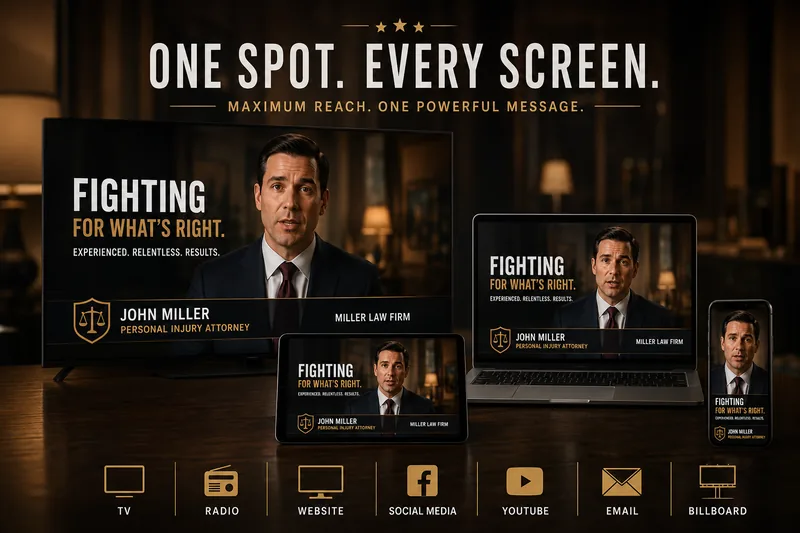
One consistent campaign beats five disconnected pieces.
A campaign — a :30, two :15s, a short bumper, plus social cuts and banners — isn't just convenient packaging. It mirrors how advertising science says campaigns must work to build durable memory. Google/Kantar CrossMedia studies across 223 campaigns found integrated campaigns are 31% more effective than non-integrated ones, and Analytic Partners found that each additional channel can improve ROI by up to 35%. Pairing streaming TV with social has been shown to deliver up to 2.8× higher unaided recall versus social alone.
The mechanism is memory synergy: a viewer may need three exposures on one channel for a message to stick, but only one exposure across three channels for the same effect. A firm that sources its TV spot from one shop, social from a freelancer, and banners from an agency gets inconsistent tone and visual language — exactly what defeats this effect. A single campaign solves it structurally.
Sources: Google / Kantar CrossMedia; Analytic Partners; Universal Ads; DVJ Insights; brand-consistency meta-analyses (Adweek, McKinsey, HubSpot).
Audiences moved to streaming. Legal advertisers mostly haven't.
Legal advertisers are systematically underinvesting in exactly the channels audiences have migrated to — and that creates a real, time-bounded window. Streaming reached 47.5% of all TV viewing in December 2025 (Nielsen), yet legal advertisers capture only about 2.72% of local connected-TV impressions. That's a gap of roughly 25 percentage points of audience that legal advertising barely reaches. Firms that have shifted to connected TV report meaningful jumps in signed cases and call volume.
A cinematic spot produced at broadcast quality translates perfectly to streaming — the production value signals premium placement. In markets where connected-TV penetration among legal advertisers is still in the single digits, a firm with a cinematic campaign has room to build a strong streaming presence while the category is uncontested.
Sources: Nielsen, The Gauge (Dec 2025); Taqtics streaming/CTV analyses; LawFirm-CMO.

One firm per market is the value, not a limitation.
When several firms advertise in one market with interchangeable creative, all of them pay the price of decision fatigue: consumers faced with five near-identical options frequently make no decision, default to price, or choose at random. Exclusivity mitigates that dynamic. Your firm becomes the recognizable choice in that cinematic frame — the familiar default built by uncontested repeat exposure, and a perceived authority, because being the only firm in that market at that level of production reads as a quality signal.
The market math supports it. In a few DMAs, two or three dominant spenders control 40%+ of impressions and own the market. But in most markets, roughly fifteen firms cluster so tightly that nobody controls more than about 8% — meaning the market is genuinely open to whoever differentiates first. An exclusive cinematic campaign is the mechanism to claim that lead without outspending everyone. And the scarcity is real: once a firm signs for a market, that market is closed.
Sources: Taqtics market-share analysis.
Production quality without story doesn't win. Together, they break through.
One finding in the research is worth confronting directly, because it strengthens the model rather than weakening it: production quality alone, without genuine storytelling, does not outperform lower-budget creative. In one study a high-budget, low-story ad scored 4.5 out of 10 on emotional resonance, while a modest-budget, authentic-story ad scored 8.2. The lesson isn't that cinematic production doesn't matter — it's that cinematic execution plus real storytelling is what creates work that breaks through. As the saying goes in legal marketing, without a story you're just another lawyer.
That's exactly the combination behind this model: authentic local storytelling — your attorney's own presence and voice, whether captured on a Birmingham shoot day or built as a labeled AI double, delivered through cinematic visual language. It's what none of the 90% of look-alike ads are doing.
Sources: Wistia production-quality study; HypeX Digital; ADVIDS emotional-resonance research; Michael Mogill.
The case, at a glance.
| Dimension | Key evidence |
|---|---|
| Market size | $4B+ in annual U.S. legal ad spend; 30M+ ads; rapid YoY growth |
| Creative gap | ~90% of PI firms look identical when audited |
| Cinematic credibility | +143% brand-credibility score (35→85) from high production value |
| Message retention | 95% retention from video vs. 10% from text |
| Creative multiplier | Creative quality can lift ad profitability up to 12× |
| TV halo effect | Measurable lift in web traffic & conversions after TV begins |
| Integrated campaigns | 31% more effective than non-integrated; +up to 35% ROI per added channel |
| Streaming gap | Legal captures ~2.72% of CTV impressions vs. ~47.5% audience share |
| Exclusive territory | Reduces decision fatigue; the exclusive firm becomes the recognizable choice |
Full citations and links are included in the free downloadable guide. Figures are drawn from third-party advertising and media research; individual firm results vary by market, spend, and execution.
Prefer to read it online? Read the complete guide →
See if your market is still open.
One firm per market. Whoever signs first locks the rest out for a year.